

How To Repair T 29 Valve
Overview
Aortic valve repair and aortic valve replacement are procedures that care for diseases affecting the aortic valve, 1 of four valves that control claret menses through the heart.
The aortic valve helps keep blood flowing in the correct direction through the heart. Information technology separates the middle's main pumping sleeping room (left ventricle) and the principal artery that supplies oxygen-rich blood to your torso (aorta).
With each contraction of the ventricle, the aortic valve opens and allows blood to flow from the left ventricle into the aorta. When the ventricle relaxes, the aortic valve closes to forestall blood from flowing backward into the ventricle.
When the aortic valve isn't working properly, it can interfere with blood flow and force the heart to work harder to send claret to the remainder of your torso.
Aortic valve repair or aortic valve replacement can treat aortic valve disease and help restore normal blood catamenia, reduce symptoms, prolong life and help preserve the part of your heart muscle.
Types
- Annuloplasty
- Valvuloplasty
Why it'due south done
Aortic valve affliction treatment depends on the severity of your condition, whether you're experiencing signs and symptoms, and if your condition is getting worse.
Types of aortic valve disease that may crave treatment with aortic valve repair or replacement include:
- Aortic valve regurgitation: This occurs when blood flows astern through the aortic valve into the left ventricle each fourth dimension the ventricle relaxes rather than in the normal, i-manner direction from the ventricle to the aorta. Back flow may be caused by a dysfunctional or leaky valve. This may be due to deterioration of the valve, an abnormal valve shape present at birth (congenital heart disease) or by a bacterial infection.
- Aortic valve stenosis. The stenosis causes the aortic valve to become narrowed or obstructed, which makes it harder for the eye to pump blood into the aorta. This may be acquired by congenital eye disease, thickening of the valve's closure flaps (leaflets) or mail-inflammatory changes, such as those associated with rheumatic heart disease.
- Congenital heart illness. Having this may contribute to aortic valve regurgitation or stenosis, as well as outcome in other problems that prevent the aortic valve from working properly. For case, a person may be born with an aortic valve that doesn't have plenty tissue flaps (cusps), the valve may exist the wrong size or shape, or there may not be an opening to allow blood to menstruum unremarkably (atresia).
For some people with mild aortic valve illness without symptoms, careful monitoring under a physician's supervision may exist all that's needed.
But in about cases, aortic valve affliction and dysfunction go worse despite medical treatment. Most aortic valve conditions are mechanical bug that can't be successfully treated with medication alone. Such weather condition eventually require surgery to reduce symptoms and your run a risk of complications, such as middle failure, heart attack, stroke or decease due to sudden cardiac arrest.
Aortic valve repair or replacement?
Related information
Transcatheter aortic valve replacement (TAVR)The decision to repair or replace a damaged aortic valve depends on many things, including:
- The severity of your aortic valve disease
- Your age and overall wellness
- Whether yous need center surgery to correct another heart trouble in add-on to aortic valve disease, such equally eye featherbed surgery to treat coronary artery disease, so both conditions can be treated at once
In general, centre valve repair is usually the first choice because information technology is associated with a lower take chances of infection, preserves valve force and function, and reduces the need to have blood-thinning medications for the rest of your life, which may be necessary with certain types of valve replacement. For example, people with a hole in the valve'due south closure flaps (perforated valve leaflet) may be candidates for aortic valve repair rather than replacement, depending on the severity of their condition.
Notwithstanding, near valves cannot be repaired, and centre valve repair surgery is oftentimes harder to do than valve replacement. Your best choice will depend on your individual state of affairs, as well equally the expertise and feel of your wellness care squad.
Aortic valve repair and aortic valve replacement may be done through traditional open-heart surgery, which involves a cutting (incision) in the chest, or past using minimally invasive methods, which involve smaller incisions in the chest or a catheter inserted in the leg or chest (transcatheter aortic valve replacement, or TAVR).
Minimally invasive center surgery may involve a shorter infirmary stay, quicker recovery and less pain than traditional open-middle surgery.
What type of procedure you have depends on your individual situation, and your doctor will explain the benefits and risks of each selection.
For example, some people with aortic valve disease may not be candidates for traditional open-heart surgery due to other wellness problems, such as lung or kidney illness, that would brand the procedure too risky.
Many people with aortic valve disease also have coronary artery disease and may need heart bypass surgery to improve blood menses. Centre bypass surgery is normally performed through traditional open-heart surgery, so your aortic valve process would be performed the same way.
Risks
Aortic valve repair and aortic valve replacement surgery risks vary depending on your health, the type of procedure and the expertise of your health care team. To minimize potential take chances, aortic valve surgery should generally exist performed at a center with a multidisciplinary center team experienced in these procedures and that performs high volumes of aortic valve surgeries.
Risks associated with aortic valve repair and aortic valve replacement surgery may include:
- Haemorrhage
- Blood clots
- Valve dysfunction in replacement valves
- Heart rhythm issues
- Infection
- Stroke
- Death
How you prepare
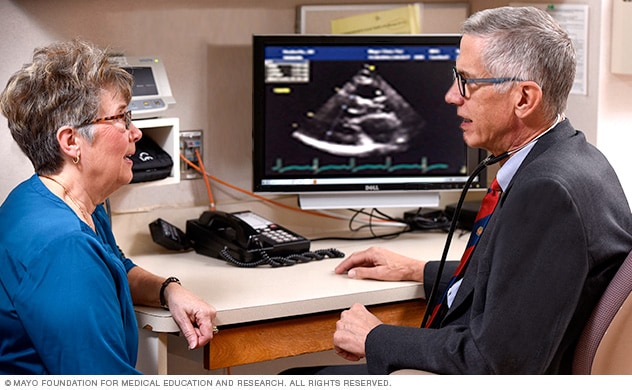 Aortic valve repair and replacement consultation at Mayo Dispensary
Your Mayo Clinic treatment squad will discuss any questions you might accept about your aortic valve repair or aortic valve replacement procedure at Mayo Clinic.
Before surgery to have your aortic valve repaired or replaced, your doctor and treatment squad volition explain to y'all what to look before, during and after the surgery and potential risks of the surgery.
Talk over with your doctor and treatment team whatsoever questions y'all may accept about the process.
Before being admitted to the infirmary for your surgery, talk to your caregivers about your hospital stay and discuss whatsoever assist you may need when y'all return habitation.
Food and medications
Talk to your doctor well-nigh:
- When you can accept your regular medications and whether you lot can accept them before your surgery
- When y'all should cease eating or drinking the night before the surgery
Clothing and personal items
Your treatment team may recommend that you bring several items to the infirmary including:
- A list of your medications
- Eyeglasses, hearing aids or dentures
- Personal care items, such as a castor, rummage, shaving equipment and toothbrush
- Loosefitting, comfortable clothing
- A copy of your advance directive or living will
- Items that may help you relax, such as portable music players or books
- Whatever prescribed medical devices or equipment
During surgery, avert wearing:
- Jewelry
- Eyeglasses
- Contact lenses
- Dentures
- Nail smoothen
Your body hair will be shaved off at the location where the procedure will accept place.
What you can await
Before the process
For nigh aortic valve repair and aortic valve replacement procedures, yous'll receive anesthetics then yous won't experience any pain, and you'll be unconscious during the surgery.
Yous'll also exist connected to a heart-lung featherbed machine, which keeps blood moving through your body during the procedure.
During the procedure
Aortic valve repair
Aortic valve repair is usually performed through traditional open-middle surgery and opening of the breast bone (sternotomy). Doctors wire the bone back together after the process to preclude movement and assist in healing.
Aortic valve repair procedures may involve several different types of repair, including:
- Inserting tissue to patch holes or tears in the flaps (perforated cusps) that close off the valve
- Calculation back up at the base or roots of the valve
- Separating fused valve cusps
- Reshaping or removing tissue to allow the valve to close more tightly
- Tightening or reinforcing the ring around a valve (annulus) by implanting an artificial ring (annuloplasty)
Aortic valves that tin can't open fully due to aortic valve stenosis may exist repaired with surgery or temporarily with a less invasive procedure called balloon valvuloplasty — which uses an approach called cardiac catheterization. You're usually awake during cardiac catheterization.
During balloon valvuloplasty, your doctor inserts a thin, hollow tube (catheter) in a blood vessel, unremarkably in your groin, and threads it to your heart. The catheter has a balloon at its tip that can be inflated to aid stretch the narrowed aortic valve and then deflated for removal.
Airship valvuloplasty is frequently used to care for infants and children with aortic valve stenosis. However, the valve tends to narrow again in adults who have had the procedure, so it's unremarkably only performed in adults who are too ill for surgery or who are waiting for a valve replacement. Yous may need additional procedures to treat the narrowed valve over time.
Some replacement heart valves may begin to leak or non piece of work as well over time. These issues tin be fixed using surgery or a catheter procedure to perform aortic valve repair by inserting a plug or device to set a leaking replacement heart valve.
Aortic valve replacement
In this procedure, your medico removes the aortic valve and replaces it with a mechanical valve or a valve fabricated from cow, sus scrofa or human center tissue (valve). Another type of biological tissue valve replacement that uses your ain pulmonary valve is sometimes possible.
Often, biological tissue valves eventually need to be replaced because they degenerate over time. If yous take a mechanical valve, you'll need to take blood-thinning medications for the rest of your life to prevent blood clots. Doctors will discuss with you the risks and benefits of each type of valve and hash out which valve may be appropriate for you.
Aortic valve replacement surgery may exist performed through traditional open up-centre surgery or minimally invasive methods, which involve smaller incisions than those used in open-heart surgery. Transcatheter aortic valve replacement (TAVR) is another type of minimally invasive aortic valve replacement that has a nonsurgical approach. It is as well sometimes called transcatheter aortic valve implantation (TAVI).
But minimally invasive aortic valve replacement is less mutual considering not all situations are best addressed by this method of access to the damaged valve. When performed past experienced surgeons and centers, the results are similar to those with traditional open up-heart surgery.
Later the process
If you lot had open up-eye surgery, you'll more often than not spend a day or more in the intensive care unit (ICU). You lot'll exist given oxygen, fluids, nutrition and medications through intravenous (Four) lines. Other tubes volition drain urine from your bladder and drain fluid and blood from your chest.
Subsequently the ICU, you'll exist moved to a regular infirmary room for several days. The time you spend in the ICU and hospital tin vary, depending on your condition and procedure.
During your hospital stay, your treatment squad volition:
- Watch for signs of infection in your incision sites
- Periodically check your blood pressure, breathing and eye charge per unit
- Work with you to manage any pain y'all have after surgery
- Encourage you to walk regularly to gradually increase your action and do breathing exercises equally you recover
Recovery time depends on your process, overall wellness earlier the procedure and any complications.
Your doctor may advise you to avert driving a automobile or lifting annihilation more 10 pounds for several weeks. Your physician will discuss with you lot when you can render to normal activities.
Results
 Aortic valve repair and replacement consultation at Mayo Dispensary
Your Mayo Dispensary handling squad will provide ongoing, coordinated care after aortic valve surgery.
After aortic valve repair or aortic valve replacement surgery, you lot may eventually be able to return to daily activities, such as working, driving and exercise.
You'll still need to take certain medications and attend regular follow-up appointments with your physician. You may have several tests to evaluate and monitor your condition.
Your medico and health intendance squad may instruct y'all to incorporate salubrious lifestyle changes — such as physical activity, a healthy nutrition, stress management and avoiding tobacco use — into your life to reduce the risk of future complications and promote a healthy heart.
Your md may recommend that you participate in cardiac rehabilitation — a program of education and practise designed to aid you improve your wellness and aid you recover later heart surgery.
Clinical trials
Explore Mayo Dispensary studies of tests and procedures to help prevent, find, treat or manage atmospheric condition.
Aug. 07, 2022

How To Repair T 29 Valve,
Source: https://www.mayoclinic.org/tests-procedures/aortic-valve-repair-aortic-valve-replacement/about/pac-20385093
Posted by: meighanlestere.blogspot.com
0 Response to "How To Repair T 29 Valve"
Post a Comment